
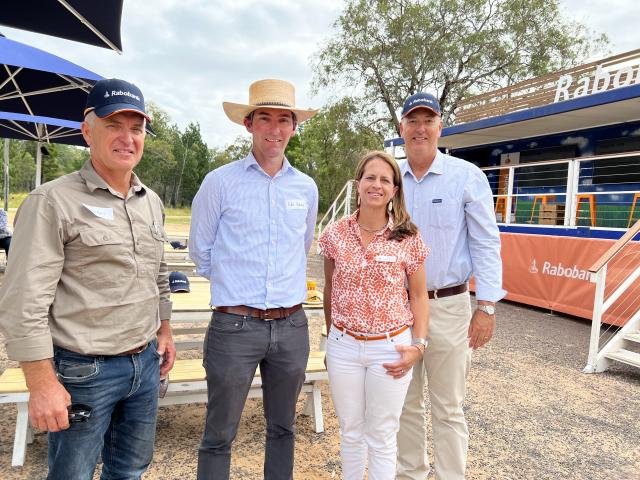
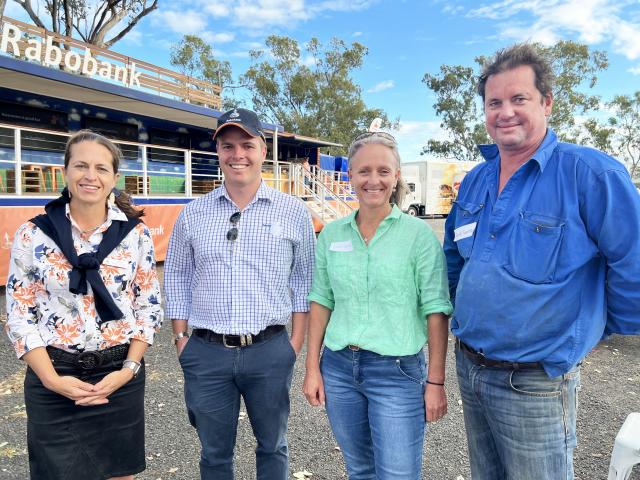
Three questions raised repeatedly at farmer forums in Cecil Plains and Moonie last month reflect the current mood of southern Queensland croppers, according to senior commodity analyst Cheryl Kalisch Gordon.
Rabobank’s Dr Kalisch Gordon headlined both meetings that featured the Rabotruck – a mobile knowledge and networking venue – and the Heart of Australia truck, which provided free health screens throughout the day.
It was supported by Rabobank’s Community Fund initiative.
In all, 90 people attended both events that also featured sessions by Murdoch Lawyers director Tony Randall and Rabobank Sustainability and Community general manager Marc Oostdijk.
“It was a great mix of knowledge for the brain and support for the body, together with networking, which is good for the soul,” Dr Kalisch Gordon said.
The Hot Topics were:
How long do we expect cotton prices to be at the levels we’re seeing this month and last?
Cheryl Kalisch Gordon
There is a lot of speculative interest in the market at the moment, ahead of there being a large volume of outstanding mill contracts expiring in July. This means there is a lot of physical cotton that needs to be fixed against those contracts.
In the lead up to that time, we’re seeing speculators come to the market because there is the opportunity for profits. Once we move towards the expiration of those contracts, I am expecting a drop in the market.
However, we’re still in a tight and uncertain market and there are questions about the outlook for the US crop, particularly in Texas and Oklahoma where conditions haven’t so far been conducive for an impressive crop due to drought.
We’re also watching for growing dryness in Brazil.
So, those production threats plus the incoming lower stocks globally, as well as the renewed interest in commodities in an inflationary environment, means we think prices will soften but not dramatically.
At the moment, we’re trading in the 900s. The question for farmers, who are currently harvesting their crops, is, ‘Can we go higher?’
I think with volatility, we could potentially go a bit higher but sustained higher? No.
What is happening with chickpea pricing?
Cheryl Kalisch Gordon
Chickpeas are a beneficial part of crop rotations and most farmers will keep them despite their pricing not enjoying the upside that we’ve seen on wheat, barley and oilseeds.
So, farmers will ask, ‘Can I afford to move out of my rotation? Is there an upside that makes me feel comfortable keeping them? Or is there another pulse that might be performing better?’
So, when it comes to chickpeas, my expectation is that we won’t see any lifts this calendar year because India has had an improved year-on-year crop, after a favourable year last year.
For us to see sustained and significant upside in prices for chickpeas in Australia, we need India to have a deficit in production but this will be their second year in a row of recording a pulse surplus.
So, when you add that with the challenges of getting containers, both in terms of high costs, availability and delays, especially to the subcontinent region, the pricing outlook is challenged.
In addition, and even if there was upside in Indian domestic pricing, you would need to overcome the tariff, which remains in place.
And then, on top of that, there are a lot of chickpeas in storage in Australia. So, as soon as we do see some price uplift here, we’re likely to see sales that will keep much upward price pressure from developing and keep them stable at current levels.
When do we expect farm inputs prices to fall?
Cheryl Kalisch Gordon
We’ve had prices on inputs growing for quite some time.
If we look at something like agrichemical, we think we’re probably past the highs but we also don’t think that we’re going to return to the average pricing we saw pre-Covid.
Because energy prices and other costs of production are higher – and there is strong demand because you’ve got a lot of people wanting to grow crops to take advantage of the high prices – it will keep prices from completely correcting.
So, on that front, we’re not going to go back to the heights of the cost but neither do we expect a return to average pricing that we’ve been used to.
If we consider fertilisers, there are a couple of different elements there.
Urea has got a more diverse supply base internationally so it may soften in the second half of the year as we pass through the northern hemisphere winter cropping planting program.
Again, we don’t think it drops back too much and the fact that Europe is considering cutting gas from Russia is something that would keep prices high, as well as deliver additional price volatility again. And, that is because they’re pretty reliant on Russia for gas. And, the cost of the gas component is 85 per cent so it is really just going to move with the gas prices.
With something like potash, meanwhile, of which some 40pc is sourced from the Black Sea region, so Russia and Belarus, we’re not seeing any foreseeable decline in the pricing of potash.
What would be the game-changer there would be some additional capacity coming on board from Canada. So, that’s what we’ll be looking for.
My advice to farmers is to keep assessing their margins and be aware of the difference in costs. High prices are great, of course, but it’s all again just about your margins.
Precision application of inputs will really pay off in the 2022/23 cropping year.