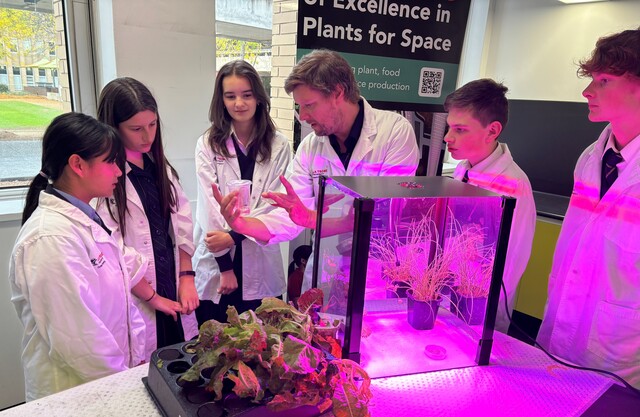
A soft pink glow lights the faces of enthusiastic students dressed in white lab coats as they study plants growing in purpose-built grow boxes destined for space stations.
Secondary students united at La Trobe University in April for the Plants for Space immersion day.
In this national project, students in years seven to 10 grow plants in controlled conditions to test their suitability for NASA missions, with the aim of helping to feed a crew of hungry astronauts.
Students’ results will then determine the most nutritious plants for space travel.
Dr Frazer Thorpe, La Trobe University Animal Plant and Soil Sciences educational and engagement manager said the initiative complemented the Australian curriculum and gave students a unique introduction to gardening through science.
He said the project’s premise was to create “zero waste” plant resources on demand that thrived in space.
“All of that knowledge is then going to be brought back to Earth and be really useful for sustainable farming,” Dr Frazer said.
“This whole project is about growing plants in enclosed environments. The use of chemicals, fertilisers, nutrients and lighting. It’s about increasing productivity in enclosed environments.”
Dr Thorpe said astronauts on the International Space Station relied on a pre-packaged diet that was frequently replenished via food drops.
But, in the long term, space gardens providing fresh, edible plants would sustain astronaut health and wellbeing.
In Plants for Space, students build the “growth habitat” inside a box the size of a large microwave fitted with LED lights and sensors.
Then they plant the seeds of a leafy green called misome, which grows reliably and quickly – both on and off-Earth.
Students gain valuable experience running their own experiments, including planting the seeds in pots and using growth media that match the NASA Vegetable Production System (Veggie).
They monitor growth and water use, making notes about plant size, colour and fitness. Students learn what plants need, how fast they can grow, what can be recycled and how much can be harvested. Also, does anyone want to eat it?
Dr Frazer said Plants For Space was linked to the Australian curriculum through “science as a human endeavour”. This related to the role of science in society, including how scientific knowledge influenced people’s lives and could be used to make decisions.
He said another important part of the project was the emotional connection with nature that promoted interest in learning about sustainability and, in turn, caring for natural resources.
“I am trying to ensure that the students of today have the skills and knowledge in which they can see science as a potential career choice,” Dr Frazer said.
“And the way I’m doing that is by supporting the teachers and providing these kind of curriculum-aligned, curriculum-enriched activities that supports what the teachers are doing.
“So, my real passion is making sure we can support the teachers to be able to support the students and, in turn, support society.”