The threat of disease destroying Australia’s $4.2 billion cotton industry has prompted expert groups to unify to protect crops and support a burgeoning export market.
A $13 million partnership between the Cotton Research and Development Corporation (CRDC), University of Southern Queensland (UniSQ) and the Queensland government seeks to offer new strategies to help growers across Australia.
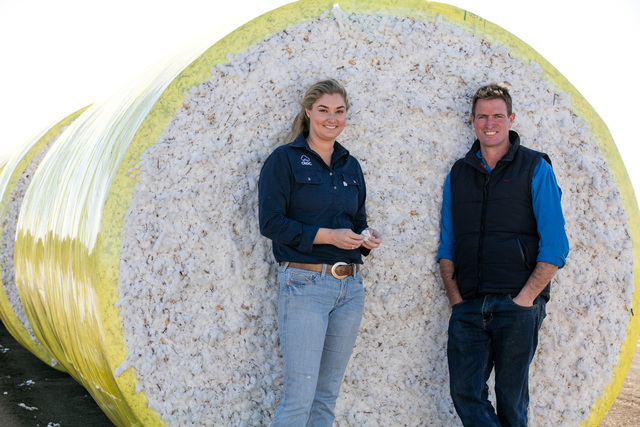
Fifth-generation cotton grower Mick Humphries, Moree, NSW, hopes a collaborative approach can unlock new solutions.
He said diseases typically cost his business about 20 per cent of his gross income annually.
“I want to claw that 20 per cent back, so I’m hopeful that bringing experts together in a strategic, coordinated way eases the burden for cotton growers into the future,” Mr Humphries said.
“Disease is a challenging area to get meaningful R&D (research and development) breakthroughs.
“We make headway on a promising solution and then, BAM! It’s back to the drawing board.
“Couple that with the piecemeal ‘one project here, one project there’ approach the industry has relied on for the past 30 years and it means new solutions aren’t coming fast enough.”
Australian cotton exports hit $4.2 billion in 2022-23 from $2.2 billion in 2021-22 as year-on-year volume figures surged nearly 70pc higher.
But, with this booming sector under constant threat of new diseases – and climate change threatening to increase the spread – CRDC is contributing its single biggest investment through the Australian Cotton Disease Collaboration (ACDC).
CRDC innovation broker Elsie Hudson said the ACDC, launched last month, hoped to cut the economic effect of current and emerging diseases from 14pc to less than five per cent by 2028.
She said the goal was to implement modern research and development methods to overhaul the approach taken to defend against diseases.
“Disease is a critical challenge for Australia’s cotton industry, contributing to significant yield losses, which undermine long-term confidence in growing cotton,” Ms Hudson said.
“In extreme cases, disease pressure is forcing some growers to opt out of cotton production.”
Research commissioned by the CRDC found disease was causing an eight per cent reduction in yield while those directly affected have lost 12pc on average and the more extreme cases have had 100pc of their crops wiped out.
“Their entire crop is at risk,” Ms Hudson said.
“While CRDC has invested in cotton disease research over several decades, the impact disease is having on growers’ profitability and productivity is increasing.
“A new approach is needed to overcome this persistent, leading limitation in the cotton production system.”
UniSQ Associate Professor Sambasivam Periyannan, director of the program, said the university’s Toowoomba campus in Queensland was uniquely positioned to lead the project.
“UniSQ is a renowned agricultural, research-intensive university, strategically located in Toowoomba on Queensland’s Darling Downs – a prime cotton-growing region.
“This collaboration will enhance UniSQ’s research capabilities and bring significant benefits to CRDC, training next-generation researchers and consultants for the cotton industry.
“As a nationwide collaborative project, ACDC brings multiple experts from various agencies together to tackle disease in cotton.
Importantly, this project will look to extend beyond national borders, and collaborate with cotton researchers from leading cotton-producing countries overseas, namely, USA, India, China, Brazil and Pakistan.
“Through knowledge and material sharing, this global network will ensure the Australian cotton industry’s preparedness and contribution to the global cotton industry’s resilience against outbreaks of new strains of cotton pathogens.”
The Queensland government’s department of agriculture and fisheries will also contribute to the collaborative program.
The problem:
* Disease is causing an eight per cent reduction in yield in the Australian cotton industry.
* For growers directly affected by disease, they are seeing an average reduction in yield of 12pc.
* In some extreme cases, it can be as high as 100pc: their entire crop is at risk.
* While CRDC has invested in cotton disease research over several decades, the impact disease is having on growers’ profitability and productivity is increasing.
The solution:
* A $13 million landmark partnership between the Cotton Research and Development Corporation (CRDC), the University of Southern Queensland (UniSQ) and the QLD Department of Agriculture and Fisheries (DAF) will help safeguard Australian cotton growers against the rising threat of disease and mitigate the economic impacts.
* CRDC is making its largest ever single investment in a first-of-its-kind collaborative approach to cotton disease research: the Australian Cotton Disease Collaboration (ACDC).
* ACDC changes the game for growers, delivering a comprehensive coordinated national disease program that will help understand the impact of disease, enhance foundational pathology resources and capability and deliver tactical management and innovative technical solutions.
* The goal is to reduce the economic impact of current and emerging diseases of cotton to less than five per cent of the cost of production – down from 14 per cent – by 2028 through practice change and research, development and extension (RD&E).
* ACDC is the first initiative announced under CRDC’s new five-year strategic RD&E Plan, Clever Cotton.
* ACDC embodies the industry’s bold, ambitious new approach to solving industry-defining challenges: a shift away from smaller projects to bigger investments with bigger outcomes and bigger impact.