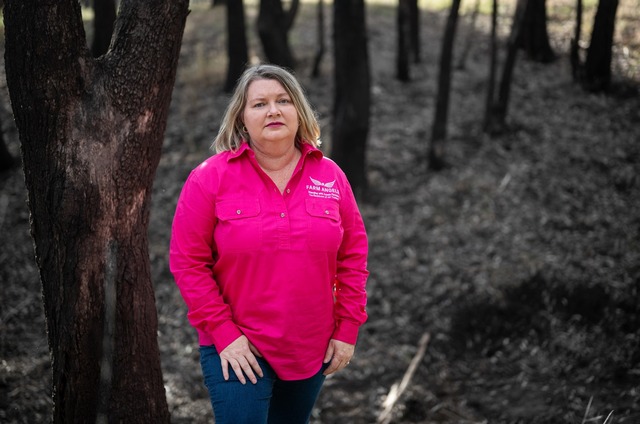
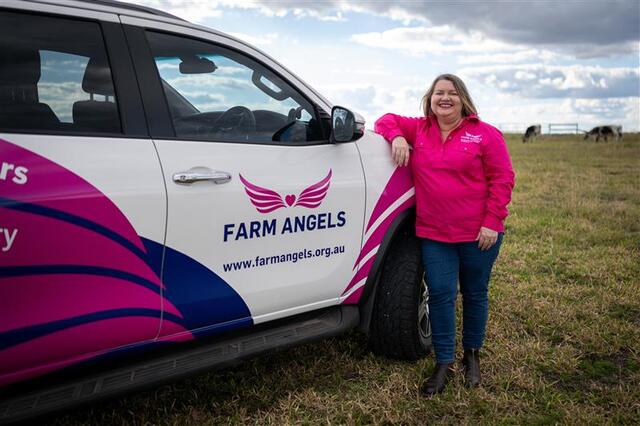
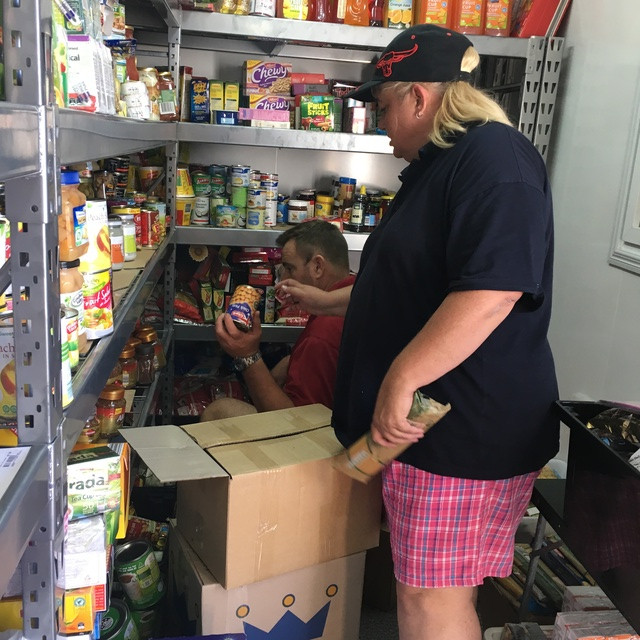
When Tash Johnston began packing grocery hampers in backyard shipping containers in 2014, she wasn’t thinking about building a national charity.
She was responding to something far more personal – the quiet strain she could see etched across the faces of the farmers around her.
More than a decade later, the founder of Farm Angels is widely recognised as one of Australia’s most influential rural characters, breaking the mould of what leadership in agriculture looks like and revolutionising the way farmer care is delivered.
Working from that original shed, Tash saw a gap that statistics and policy papers often missed.
“We knew of people in the farming community who were carrying the weight of the world on their shoulders to feed our country,” she said.
“They did it all on their own, without asking for any help. But I could see the silent toll it was taking and I knew I wanted to change that.”
That instinct — to listen first and act with compassion — has shaped Farm Angels into a lifeline for farming families.
With a focus on mental health and practical relief, the organisation has supported more than 4800 farming families across 1400 Australian communities.
The past two years alone have tested the limits of even the most resilient rural support networks.
“I guess over the past couple of years, there’s been disasters in South Australia – really bad droughts – floods in western Queensland, floods again in western Queensland this year and now the fires in Victoria,” Tash said.
“Yes, we never stop.”
From drought to flood to fire, demand for assistance has surged. Farm Angels’ applications for support have increased by 150 per cent, forcing rapid growth within the organisation.
“We’re a team of 16 now and we are looking at expanding that at the moment because obviously our application for assistance has gone up 150 per cent,” she said.
“Between natural disasters in South Australia, Queensland and Victoria, we are getting absolutely inundated.”
Despite the growth, Tash is adamant that scale will never replace sincerity. Farm Angels’ support model is deliberately personal and resource-intensive.
“Our farmer support team are certainly working their tails off, doing an incredible job, as they always do,” she said.
“You know, having personal contact is excellent and we need the right people to do that, too. Like our farmer support team is made up of farmers themselves.”
Farmers can reach out online or by phone, a critical flexibility in regions where connectivity can be unreliable.
Every applicant undergoes an initial assessment, where the team learns about their enterprise and circumstances before beginning tailored support.
Support can range from prepaid Visa cards for essential expenses to ongoing case management over 12 months or longer if needed.
It is always case-by-case, guided by listening rather than assumptions.
The emotional weight primary producers carry is never far from the surface.
“It is a very, you know, it’s disheartening for them,” Tash said, referring to mounting pressures including price volatility.
“With so much hard work … And then not to believe you are being compensated correctly must be exhausting.”
When disaster strikes – a flood washing away fences, a fire ripping through pasture – the mental fog can be overwhelming.
“I think when you’re in those moments, you can’t think clearly,” she said. “You can’t make a good decision.
“So, to have somebody standing by you, helping point you in the right direction, or from the distance, I think it helped to take some of the clouds away.”
The reward for that steady presence often comes quietly.
“I had a beautiful farmer … and she just rang me on the phone last week to say, ‘I just never got around to ringing you and thanking you. I just wanted to thank you so much and what a difference you made to us’,” Tash recalled.
“When I get those phone calls or see people that come up and say thank you, they’re the most heartwarming and rewarding moments.”
Based in Crow’s Nest near Toowoomba, Tash continues to travel regularly to affected regions. It is in those community gatherings that her purpose is reaffirmed.
“It’s when I do these groups that it’s like, ‘This is why I do what I do. This is what I love’,” she said.
Recognition, including being awarded the Medal of the Order of Australia, is humbling but she sees it as belonging to the broader rural community.
“I think it’s just a great recognition for all the hard work … and the difference that we help to make within, you know, communities and lives and businesses.”
Looking ahead, Tash’s ambitions are pragmatic but bold. She is working to secure long-term strategic partnerships to provide stability for the charity and to expand its footprint nationally.
“So, having somebody based in each state would be our big goal right now,” she said.
Rural communities, she believes, rely on trust and relationships. Embedding Farm Angels representatives within each state would deepen that connection and reduce the need to “parachute in” during crisis.
There is also the annual Flanno for a Farmer campaign in August, now in its fourth year, steadily growing as a national fundraiser.
Yet at its core, Farm Angels remains what it was in 2014 — a love letter to Australian farmers.
In an era where rural leadership is often associated with boardrooms and policy debates, Tash Johnston leads differently. Her leadership is built on kitchen tables, phone calls and front gates.
And, in a sector that too often prides itself on stoicism, she has helped make something else acceptable: Asking for a hand up.