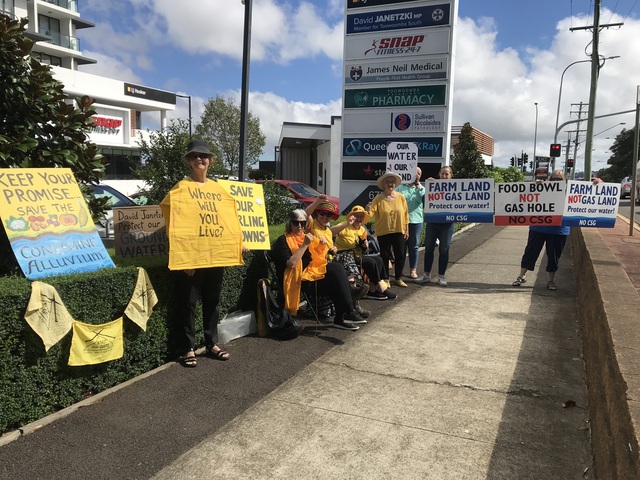
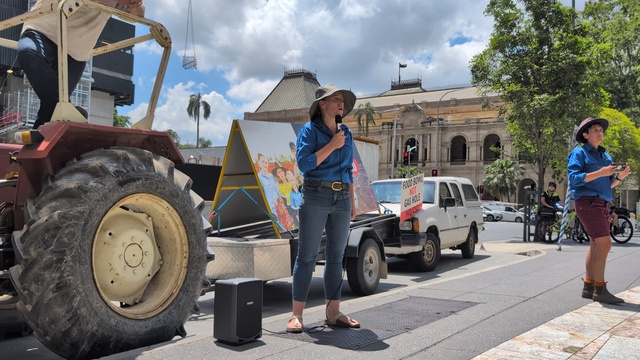
Farmers stood shoulder-to-shoulder with a group of self-described Knitting Nannas outside the Toowoomba office of Queensland Treasurer David Janetzki last month.
They called on the State Government to honour its election pledge to protect prime farmland and vital groundwater from coal seam gas expansion.
The peaceful “knit-in” was staged amid growing concern about Arrow Energy’s ongoing drilling in the region, which locals say is already affecting the Condamine Alluvium, a shallow and highly productive groundwater system underpinning agriculture across the Cecil Plains district.
Basically, in the lead-up to the 2024 state election, the Crisafulli Government promised stronger protections for the Condamine Alluvium and the fertile food bowl above it.
Condamine MP Pat Weir said at the time the government would amend legislation to require gas companies to demonstrate “beyond any reasonable doubt” that their activities would not detrimentally impact land or water connected to the alluvium.
Seventeen months on, farmers say they are still waiting.
Liza Balmain, who farms at Glendon on the eastern side of Condamine River near Cecil Plains, said local producers attended last month’s gathering to support the Toowoomba Knitting Nannas and to press for action.
“It was announced before the 2024 election that they would strengthen legislation to better protect the Condamine Alluvium whereby gas miners would have to prove – beyond any reasonable doubt – that they will not have a detrimental impact,“ Ms Balmain said.
“That’s quite a broad commitment and it’s basically where we want to be. We want to see better protections for the alluvium.
“It’s been 17 months since that commitment was made and we haven’t seen anything. We would like to see some action.”
Stretching roughly from Millmerran and Pittsworth in the south to Dalby and west to Chinchilla, the Condamine Alluvium covers a relatively small geographic footprint in Queensland.
Yet Ms Balmain describes it as the state’s most productive alluvial system – shallow, high-quality groundwater held in sands and gravels that support some of the country’s most fertile soils.
“It’s very shallow and it sits directly on top of the Walloon Coal Measures that they’re targeting,” she said.
The concern, she explained, centres on the depressurisation process used to extract coal seam gas. When coal measures are dewatered to release gas, pressure differences can cause water from the overlying alluvium to migrate downward.
“The water in the alluvium will then become at a higher pressure and it will find whatever connectivity pathways are available to it,” Ms Balmain said.
Potential pathways include natural geological faults and fractures – including a major fault system near Dalby and Cecil Plains – as well as man-made features.
Corroding or ageing gas wells may present integrity issues and historical coal exploration holes drilled from the 1960s to 1980s – some reportedly left uncapped or unsealed – add another layer of uncertainty.
“They represent another connectivity pathway waiting to happen,” she said.
Above the aquifer lies what farmers describe as an “amazing agricultural food bowl”, producing cotton, grains and other crops that rely on reliable groundwater supplies.
“There’s a lot at stake,” Ms Balmain said.
Protests against gas development in the region are not new. Ms Balmain said community resistance dated back to around 2010, when Arrow Energy first entered the area.
Large rallies were held in the early years, followed by smaller demonstrations, including a protest at Springvale last year.
“As time has gone on and our knowledge base has increased, we’re seeing all the red flags,” she said. “We’ve all done a lot of research. Once you go digging, it’s not hard to find the red flags.”
While last month’s action was peaceful – with knitting needles clicking as a symbol of quiet persistence – organisers say the message was firm: the government must deliver on its promise.
Ms Balmain said farmers were encouraged to hear recent comments suggesting legislative reform could be introduced soon, following a local media interview with Mr Weir.
“It’s good to hear that there is something coming,” she said. “But, obviously, the devil’s in the detail. Until we see the bill, we’re in the dark.”
She said there had been no direct consultation with farmers to date on what the reforms might look like.
“There is already legislation in place, but it is diluted by exemptions, which creates loopholes in bypassing planning laws,” she said.
Development has so far occurred predominantly on the western side of the Condamine River, including drilling beneath the river itself. Ms Balmain’s property, Glendon Farm, lies on the eastern side, where farmers remain determined to prevent further encroachment.
For now, the Knitting Nannas and the farmers who joined them say they will continue to apply pressure – one stitch, one protest at a time – until they see the promised protections enshrined in law.