Researchers at the University of Southern Queensland are helping to ensure Australia’s agricultural sector stays strong in the face of drought.
The research team, led by the Cooperative Research Centre for High Performance Soils (Soil CRC), is investigating how different soil treatments can increase the water-holding capacity of soil where crops are grown, to enhance their drought resilience.
The research project has just attained a research grant through the Australian Government’s Future Drought Fund: Long-Term Trials of Drought Resilient Farming Practices Program.
University of Southern Queensland’s School of Agriculture and Environmental Science and Centre for Sustainable Agricultural Systems Associate Professor Keith Pembleton said it was exciting to receive this funding.
He said it would ensure the continued collaboration between the university and Soil CRC to work against the “wicked problem” of drought.
“We can’t just turn the tap on and make it rain, so we’ve got to look at finding other ways of building resilience in Australian agriculture,” Associate Professor Pembleton said.
“Challenging problems require multidisciplinary, highly collaborative teams, to solve,” he said.
“One of the cool things about this project is that we’ve got experts from around the country coming together to work out ways of building resilience in the soil.
“We’ve also got grower groups working with us, which gives us a direct conduit to getting our research out.”
Associate Professor Pembleton said the research project was looking at different soil treatments to increase resilience in broadacre crops such as wheat, peas and canola.
“Soil itself is the foundation for our agricultural production; if we don’t have soils that are productive and resilient to drought, we’re in a whole heap of trouble in terms of being able to feed ourselves, feed our country and feed the world,” he said.
“The whole idea of these field trials is we’re testing different amendments to increase the water and nutrient-holding capacity of the soil.
“If you think of the soil as a bucket – and the plant sucks water and nutrients out of the bucket – it just makes sense that the bigger the bucket, the more water and nutrients the plant can suck out and the bigger that plant can grow.”
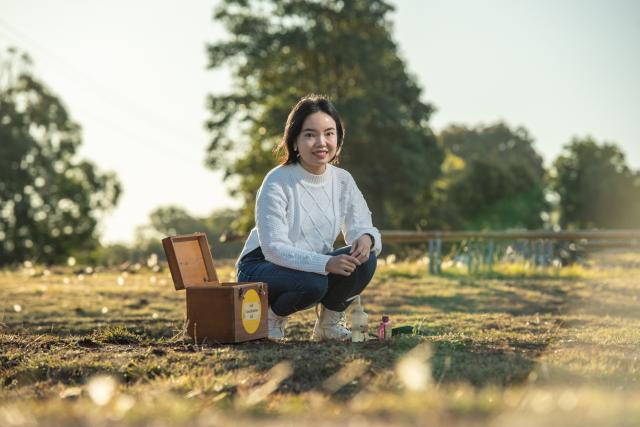
University of Southern Queensland School of Agriculture and Environmental Science and Centre for Sustainable Agricultural Systems Research Fellow Dr Chloe Lai said she was looking forward to capturing the knowledge, which would extend their field findings across space and time with confidence.
“This is important in Australia because we have very variable climate conditions which are exacerbated by climate change,” Dr Lai said.
“Our soils are relatively old, infertile and fragile to resist changing conditions. As a non-renewable resource that provides enormous ecosystem functioning and acts as cultural heritage reserves, there is a strong incentive to invest in our soil’s resilience.”
Soil CRC CEO Dr Michael Crawford said the Future Drought Fund’s Long-Term Trials of Drought Resilient Farming Practices grant would enable the Soil CRC to extend its long-term field trials beyond the current lifetime of June 2027.
“We will now be able to expand data collection for a further three years on a range of soil types and constraints with varying risk of drought,” Dr Crawford said
“I am really looking forward to the contribution to be made to the project by University of Southern Queensland researchers, especially in model development and analysis.
“This will build on the previous work undertaken by the University of Southern Queensland’s modelling team with the Soil CRC and help to increase the impact for farmers across Australia.”