
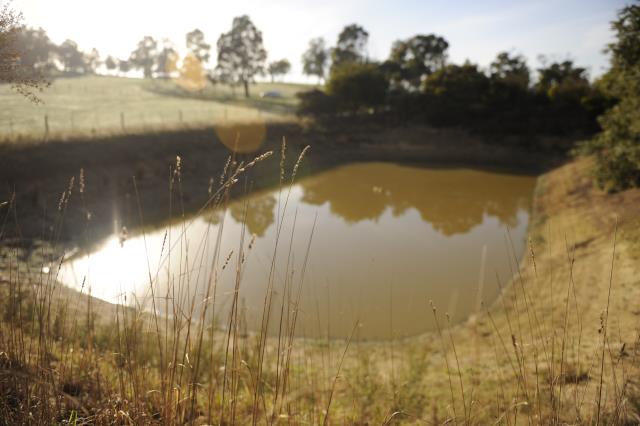
Tens of thousands of small-scale hydro energy storage sites could be built from Australia’s farm dams, supporting the uptake of reliable, low-carbon power systems in rural communities, UNSW Sydney-led research suggests.
The study found agricultural reservoirs, such as those used for solar-power irrigation, could be connected to form micro-pumped hydro energy storage systems – household-size versions of the Snowy Hydro hydroelectric dam project.
It’s the first study in the world to assess the potential of these small-scale systems as an innovative renewable energy storage solution.
And, with the increasing shift towards variable energy sources such as wind and solar photovoltaics, storing surplus energy is essential for ensuring a stable and reliable power supply.
In other words, when the sun isn’t up or the wind isn’t blowing, stored energy can help balance energy supply and demand in real time and overcome the risk of shortages and overloads.
In a micro-pumped hydro energy storage system, excess solar energy from high-production periods is stored by pumping water to a high-lying reservoir, which is released back to a low-lying reservoir when more power is needed.
It then flows through a turbine-connected generator to create electricity. However, constructing new water reservoirs for micro-pumped hydro energy storage can be expensive.
“The transition to low-carbon power systems like wind and solar photovoltaics needs cost-effective energy storage solutions at all scales,” says Dr Nicholas Gilmore, lead author of the study and lecturer at the School of Mechanical and Manufacturing Engineering at UNSW Engineering.
“We thought – if you’re geographically fortunate to have two significant water volumes separated with sufficient elevation, you might have the potential to have your own hydro energy storage system.”
Unlocking the untapped potential of farm dams
For the study, the team, which also included researchers from Deakin University and the University of Technology Sydney, used satellite imagery to create unique agricultural reservoir pairings across Australia from a 2021 dataset of farm dams.
They then used graph theory algorithms – a branch of mathematics that models how nodes can be organised and interconnected – to filter commercially promising sites based on minimum capacity and slope.
“If you have a lot of dams in close proximity, it’s not viable to link them up in every combination,” says Dr Thomas Britz, co-author of the study and senior lecturer at UNSW Science’s School of Mathematics and Statistics.
“So, we use these graph theory algorithms to connect the best dam configurations with a reasonable energy capacity.”
From nearly 1.7 million farm dams, the researchers identified more than 30,000 sites across Australia as promising for micro-pumped hydro energy storage.
The average site could provide up to 2kW of power and 30kWh of usable energy – enough to back up a South Australian home for 40 hours.
“We identified tens of thousands of these potential sites where micro-pumped hydro energy storage systems could be installed without undertaking costly reservoir construction,” Dr Gilmore says.
“That’s thousands of households that could potentially increase their solar usage, saving money on their energy bills, and reducing their carbon footprint.”
The research team also benchmarked a micro-pumped hydro site to a commercially available lithium-ion battery in solar-powered irrigation systems.
Despite a low discharge efficiency, they found the pumped hydro storage was 30 per cent cheaper for a large single cycle load due to its high storage capacity.
“While the initial outlay for a micro-pumped hydro energy storage system is higher than a battery, the advantages are larger storage capacity and potential durability for decades,” Dr Gilmore says.
“But that cost is significantly reduced anyway by capitalising on existing reservoirs, which also has the added benefit of less environmental impact.”
Building micro-pumped hydro energy power systems from existing farm dams could also assist rural areas susceptible to power outages that need a secure and reliable backup power source.
Battery backup power is generally limited to less than half a day, while generators, though powerful, are dependent on affordable fuel supply and produce harmful emissions.
“People on the fringes of the electricity network can be more exposed to power outages, and the supply can be less reliable,” Dr Gilmore says.
“If there’s a power outage during a bushfire, for example, a pumped hydro system will give you enough energy to last a day, whereas a battery typically lasts around eight hours.”
Although encouraging, the researchers say some limitations of the study require further analysis, including fluctuations in water availability, pump scheduling and discharge efficiency.
“Our findings are encouraging for further development of this emerging technology and there is plenty of scope for future technological improvements that will make these systems increasingly cheaper over time,” Dr Gilmore says.
“The next step would be setting up a pilot site, testing the performance of a system in action and modelling it in detail to get real-world validation – we have 30,000 potential candidates!”