When NASA returns the Artemis III mission to the moon in 2026 astronauts will grow plants in a mini lunar greenhouse.
In a world first, they will then return the duckweed, cress and brassica plants to Earth.
Lunar Effects on Agricultural Flora – or LEAF – is one of the three experiments chosen to travel to the moon in 2026.
It will be the first time NASA has attempted to grow plants on the moon and may be the key to feeding future space missions.
Slated for a September 2026 launch, the consortium of partners who will pioneer this initiative includes a core group from the Australian Research Council Centre of Excellence in Plants for Space (P4S), headquartered at the University of Adelaide.
“This research will be a pivotal step towards understanding how we might use agriculture in space to support human crews, paving the way for sustained lunar exploration and even missions to Mars,” said project lead and space lab vice-president Christine Escobar.
Associate Professor of Plant Synthetic Biology at the University of Adelaide and P4S chief investigator Jenny Mortimer said the mission would show how plants responded in an off-Earth environment and “how well we can build a robust, fully-contained environment that allows them to thrive“.
“The data we capture from the mission, both from the lunar surface and what we learn when we analyse the samples upon return, will help us to design the lunar and Martian crops of the future,” Associate Professor Mortimer said.
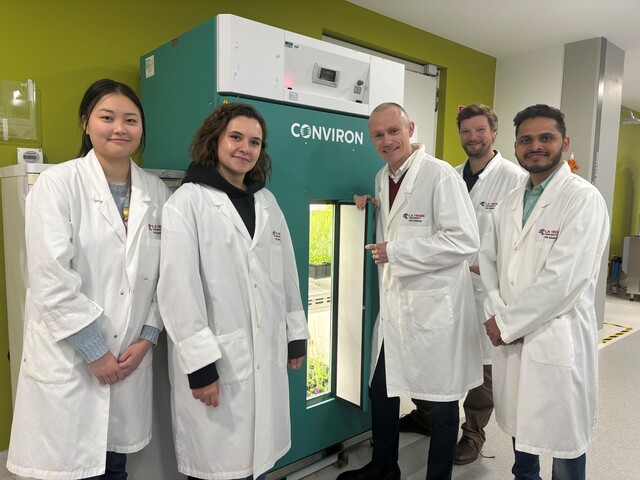
Professor Mathew Lewsey of P4S and the La Trobe Institute for Sustainable Agriculture and Food said the LEAF investigation would provide information about how plants could grow in extreme conditions.
“The seeds we send to the moon will germinate in an enclosed capsule, which we will be monitoring through a remote camera,” Professor Lewsey said.
“Our team of scientists will collect data on the plants as they grow on the moon, monitoring their size and morphology, then conduct genetic and metabolic analyses of individual cells when the plants return to Earth.
“We can then apply this knowledge to improve plant resilience to radiation and other environmental challenges.”
The LEAF experiment includes a plant growth chamber with an isolated atmosphere, housing red and green varieties of Brassica rapa (Wisconsin Fast Plants®), Wolffia (duckweed) and Arabidopsis thaliana.
Experiments undertaken as part of the LEAF program will progress P4S goals to develop novel plant-based foods and biomanufacturing technologies that help humans explore deeper into space than ever before, while also advancing on-Earth sustainability and efficiency.
“LEAF has been made possible by bringing together world-leading skillsets in engineering, plant science, molecular analysis and space logistics,“ said P4S director and University of Adelaide Professor Matthew Gilliham.
“It is a perfect representation of what P4S is here to do, to assist in delivering a new frontier for humanity.
“The learnings and technologies we gain by growing plants in a completely closed loop, as we must do in space, will provide new options for improving sustainable plant production and processing here on Earth.”
Head of the Australian Space Agency Enrico Palermo said the selection of Plants for Space involvement in Artemis is a major vote of confidence in Australia’s space sector.
“This is another example of the cutting-edge space research and innovation happening in Australia and the demand there is for us to contribute to generation-defining international missions,” Mr Palermo said.
“Importantly too, the technologies and practices developed as part of Plants for Space will improve life on Earth and benefit all Australians by addressing challenges like food security and water scarcity.”
LEAF is one of three science instruments so far selected for deployment on the moon’s surface as part of NASA’s Artemis III mission, all of which will be set up near the lunar South Pole.
The other two are a Lunar Environment Monitoring Station, a compact, autonomous seismometer suite designed to carry out continuous, long-term monitoring of ‘moonquakes’.