Supermarket shelves could be stocked with mushrooms grown from the Northern Territory’s cotton waste, with a Charles Darwin University (CDU) research project exploring the possibility of broadening the region’s agricultural industry.
The project, led by PhD candidate Waseem Ahmed from CDU’s Research Institute for Northern Agriculture (RINA), aims to create a circular economy by using cotton crop waste to grow mushrooms.
Cotton crop production in the Northern Territory has expanded to more than 10,000 hectares and is anticipated to reach 15,000 hectares in the coming years.
This process of using cotton waste – known as cotton trash – is the first of its kind in Australia, with sugarcane and wheat crop waste being the most used byproducts for growth.
Australian mushroom production is estimated to be annually around 65,000 tonnes, on top of importing about 5000t of mushrooms a year.
Mr Ahmed, who began this project in 2024, said the process has fallen into three stages: to assess the viability of using cotton trash to grow mushrooms, to develop successful recipes using cotton trash and other waste and conduct an economic analysis on the potential of the industry.
The second stage, which includes growth trials and nutrition analysis, is scheduled to be completed by the end of the year.
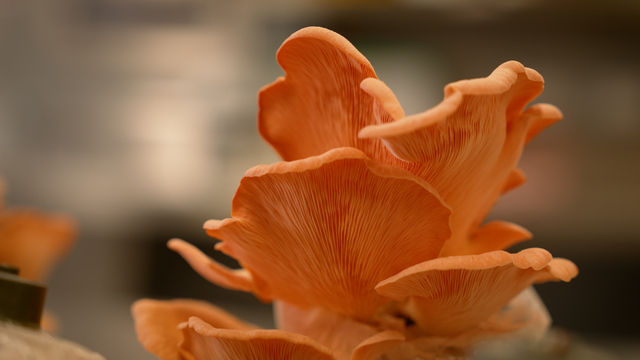
Mr Ahmed has successfully grown oyster mushrooms using cotton waste, with the testing and experiments conducted at NT Department of Agriculture and Fisheries’ Berrimah Farm Laboratories.
“Cotton is proposed to be a cornerstone crop here in Northern Territory,” Mr Ahmed said.
“We have excess of cotton trash. It’s nutrient dense and we can efficiently and strategically use it to build an industry.
“The Northern Territory currently generates 2500 to 3000t of cotton waste each year and when the agro-waste is supplemented properly, has the potential to produce 600 to 700 kilograms of mushrooms per tonne.
“This is not a $1 million, $2 million industry. This is a $100 million industry we have here. We have the major and minor ingredients; we have the supplements – all which can produce a good yield.”
Mr Ahmed said while the NT’s estimated consumption of mushrooms is around 250t, the project posed an opportunity for export.
The project is funded by the Cooperative Research Centre for Developing Northern Australia (CRCNA) and Research Training Program – Commonwealth Department of Education.
The project is being supervised by RINA Professor of Cropping Systems Stephen Xu, CDU Senior Research Fellow Dr Yujan Li, CDU Associate Professor Kamaljit Sangha and NT Government Cropping Group Leader Dr Edward Mwando.
Mr Ahmed, who comes from an agricultural family, said the research indicates the project can be scaled up from the lab with immense economic and environmental benefits for the Northern Territory.
He added this approach has the potential not only to create a healthy food source from local agro-waste but also to contribute to diversifying and strengthening the Territory’s economy.
“A circular economy approach helps to protect the environment, creates more jobs, and gives us an opportunity to use the waste, search out the benefits and recycle it again with a new approach for the betterment of society and economy,” Mr Ahmed said.
“We are going through the stage where we need more food. Our population is increasing day by day, and our resources are the same. By using the circular economy approach, we produce more, we can save more and create a sustainable system.”
Using Cotton Grain and Cattle Waste to Grow Mushroom for Circular Economy is also in collaboration with the NT Department of Tourism and Trade and the Northern Territory Farmers Association as industry partners.