When heat stress hits, cattle eat less and burn 15 per cent more energy just to maintain themselves. Reducing heat stress helps cattle maintain normal feed intake, boosting productivity and fertility—especially vital for northern Australian producers.
Simon Close, who runs Kurra-Wirra Cattle stud with his family in Culla, Victoria, is tackling this challenge head-on.
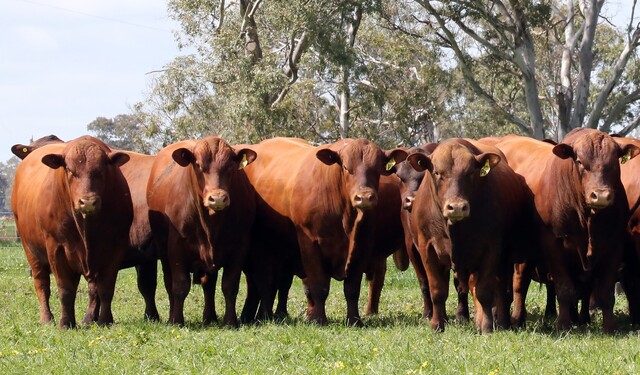
His Red Angus cattle already benefit from their red coats, which absorb less heat than black. But Simon’s secret weapon is the slick coat gene—a dominant trait that enhances heat tolerance.
“Heat stress starts at 28°C and 60 per cent humidity,” Simon explains. “Coat colour helps delay it, but the slick coat gene takes it further.”
Kurra-Wirra is believed to be the only Angus and Composite breeder in Australia, and possibly the world, testing for this gene in their herd.
Their Slick Angus cattle—red-coated animals carrying the slick gene—are registered with Angus Australia’s Performance Register (APR), which requires cattle to be at least 87.5 per cent Angus. Since testing began six years ago, Kurra-Wirra has steadily increased Angus content while retaining the slick coat advantage.
The journey began 20 years ago with Simon’s father, Robert, who spotted exceptional red cows from Brindley Park station during the 2006 drought. These Senepol–Red Angus crosses had been bred using elite US and Canadian genetics. The Close family purchased 120 heifers and began breeding for Red Angus type and slick coats—initially by eye, before genetic testing was available.
“We’re chasing classic Angus traits—growth, fertility, carcass quality—with added heat tolerance,” Simon says. “We want free-moving animals with hip height to cover long distances. Some of our cattle walk 10 to 20 km to water.”
Global genetics have been infused into the program to enhance performance. The game changed when the Livestock Improvement Company in New Zealand enabled slick gene testing. “We haven’t needed Senepol since,” Simon says. “Now we can tap into the full Angus gene pool and still retain heat tolerance.”
Kurra-Wirra sells 200–300 bulls annually, including 130 in Blackall each September. Their agent, James Lilburne, has helped connect with northern producers, and demand for slick-coated Red Angus cattle has grown. The stud supplies major cattle businesses across Queensland and the Northern Territory.
Their cattle excelled in the Westech Steer Trial in Barcaldine, winning top honours for average daily gain both in the paddock and feedlot. “We’re lucky to supply some of Australia’s biggest producers,” Simon says. “They’re crossing our bulls with Brahmans and Droughtmasters and seeing real benefits—better conformation, no horns, and docile temperaments that earn price premiums.”
In Alice Springs, one client reports slick-coated cattle are thriving and carrying impressive weight. Simon attributes this to longer grazing hours. “When cattle overheat, they rest instead of graze. A study showed slick-coated animals grazed over an hour longer than British breeds on a 28°C day. Across a herd, that adds up.”
Slick-coated cattle also have cooler rumen temperatures—0.5 to 1°C lower—thanks to shorter coats, thinner skin, and more active sweat pores. This physiological edge means better feed efficiency, faster growth, earlier puberty in females, and earlier turnoff for steers.
The slick gene offers more than heat tolerance. It provides tick and parasite resistance. “A Meat & Livestock Australia study found Senepol–Limousin cattle with the slick gene had five times fewer ticks than pure Limousins,” Simon notes.
Environmental benefits are also on the radar. “To cut methane, we need to grow more beef per cow. Faster-growing animals that leave the farm earlier emit less methane. It helps producers meet sustainability targets—something we believe is critical.”
Clients also love how slick-coated cattle look. “In the saleyards, they shine—fresh, primed, and commanding premium prices,” Simon says.
Looking ahead, the Close family aims to push Angus content even higher. Their dream? A bull sale where every animal is APR-registered and slick-coated. “We’re focused on profitable cattle—lower birthweights, higher growth, bigger carcasses—with walkability and the slick coat gene at the heart of it all.”