Authorities are concerned after fire ants were again found well outside Queensland’s containment zone.
More fire ant nests have been found west of the Great Dividing Range as the highly aggressive super pest invades new islands off Brisbane.
Australia is waging a long and costly war to eradicate the invasive species, which has profoundly affected agriculture, wildlife and people in other countries.
But there’s mounting concern over a series of recent detections outside a biosecurity containment zone, centred on Queensland’s southeast corner.
On Friday 17 May, authorities said two nests had been found at Meringandan West in Toowoomba – about 4km from Kleinton, where two nests were found in 2023.
The Meringandan West discovery is about 10km from an army site at Oakey where almost 80 nests were found in April, but authorities say the discoveries are not linked.
The Oakey detection was the first in the Murray Darling Basin, which ecologists and farmers have long feared because fire ants can join together to form rafts and harness river flows to invade new areas.
Fire ants have also recently been detected in NSW at South Murwillumbah and Wardell, south of Ballina, with those infestations stamped out. But authorities remain on high alert.
The National Fire Ant Eradication Program says it destroyed the nests found by its odour detection dog team at Meringandan West on Tuesday.
“The team was in the area conducting surveillance as part of compliance tracing activities. The tracing is not linked to the recent detection in Oakey,” the program said on Friday.
Meanwhile, there have been new detections on the Moreton Bay islands, off Brisbane.
They were found on Coochiemudlo Island and South Stradbroke Island in April, and on Russell Island in February.
That follows discoveries on North Stradbroke Island and Macleay Island in 2023.
The eradication program says all detected nests have been treated along with surrounding areas, but residents must be vigilant given what’s at stake for the environment, the economy and Australia’s way of life.
Earlier in 2024, the federal environment department warned that if fire ants became established across Australia, they would surpass the combined effects of feral cats, feral pigs, dogs, foxes, camels, rabbits and cane toads.
It warned 97 per cent of the country could be invaded by the hyper-aggressive ants, which work together to swarm and kill their prey and defeat anything that disturbs their nests.
Annual losses for Australia could reach $2 billion a year.
In other parts of the world, including China and the United States, fire ants have overrun ecosystems and changed them forever.
A risk assessment of about 120 wildlife species in Queensland’s southeast found fire ants are likely to have effects severe enough to cause population declines in 45 per cent of birds, 38 per cent of mammals, 69 per cent of reptiles and 95 per cent of amphibians.
Fire ants can spread naturally but human assisted movement, particularly in organic materials such as soil, mulch and turf, is a major risk when it comes to helping them move large distances.
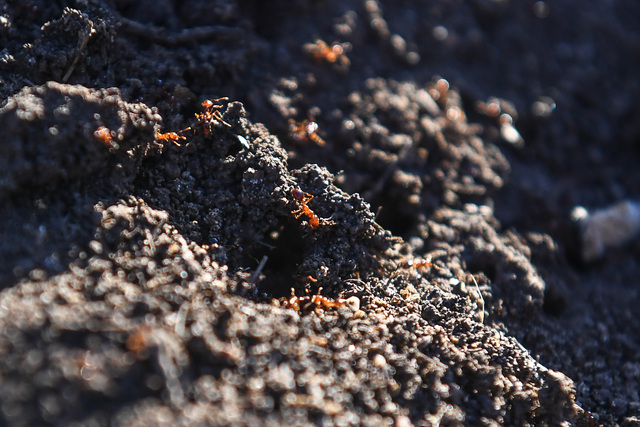
The eradication program has urged everyone to look for and report fire ants, which are copper brown in colour and have a darker abdomen.
They are two to six millimetres long, with a variety of sizes found in each nest.
Nests appear as mounds or patches of loose soil and have no obvious entry or exit holes.
Nationals Leader David Littleproud has his say on page 31