Fifty years ago, the legend of Gunsynd – the Goondiwindi Grey – began to take flight.
On 1 April 1972, the gallant grey – under the top weight of 60.5 kilograms – ran down the talented galloper Triton to win the Doncaster Handicap at Royal Randwick racecourse.
Victory at Randwick that day meant the popular galloper had now won all four of Australia’s big mile (1600 metre) races.
The Epsom Handicap, the Toorak Handicap and the George Adams Handicap (now the Kennedy Cantala Stakes run during the Melbourne Cup week carnival) were captured in an outstanding spring campaign of 1971, cementing the then Tommy Smith-trained galloper as one of the best in the land.
A win in the time-honoured W.S. Cox Plate and his memorable dead heat for third in the Melbourne Cup under 60.5kg were still to come in 1972, as was a close second to his foe Triton in the Epsom Handicap under a hefty top weight of 62.5kg.
This close second was the only time Gunsynd was beaten at 1600 metres.
Gunsynd retired in 1973 to Kia Ora stud as the winner of 29 races from 54 starts and a then prize money record of $280,455, or the equivalent of almost $15 million today.
His best progeny was his grey granddaughter, multiple Group 1 winner Emancipation, winner of the 1983 Doncaster Handicap – 11 years after her grandfather – and who was named Australia’s champion racehorse for the 1983-84 racing season.
To win all four big mile handicap races was an outstanding achievement in an era when race weights were not as compressed as they are today.
In the 1972 Melbourne Cup, Gunsynd conceded the winner Piping Lane 12.5kg or approximately two stone!
But this extraordinary achievement is recognised more today by horse racing pundits than it was at the time.
So what really created the legend that is Gunsynd?
How did a top-flight racehorse, a brilliant miler who single-handedly put a town on the map and ended up being immortalised in song, become an icon fondly remembered as much today 50 years after one of his greatest race track achievements?
Affectionately christened the Goondiwindi Grey by the racing world in the season of 1971-72 as his four owners came from the little Queensland border town, his racetrack success made him popular with punters while his grey colouring made him popular as he was easy to see in a race while it was being run.
(Remember, this was a time long before the multi-camera angle television coverage horse racing enjoys today!)
But, more importantly, beyond his looks and tenacity to win, Gunsynd had personality.
The horse was a showman. Gunsynd loved attention.
Whether it was children wanting to pat him or the thunderous applause of racegoers when he won a race, he became the people’s horse.
His popularity grew as everyday people, not just racing lovers, flocked to racetracks to see him. Similar, perhaps, to what we have seen in recent years with Black Caviar and Winx.
And, Gunsynd knew he was loved and admired, often refusing to go onto a racetrack from the saddling enclosure to compete until he thought the applause from his trackside fans was loud enough. And then, seemingly knowing he had won a race, Gunsynd would often stop in front of packed grandstands and lawn greens and bow to the crowds as he returned victorious.
His on-track racing prowess, his willingness to be loved and admired and the star antics he displayed to his fans, saw his popularity soar making the grey galloper as popular an equine in his day as the legendary Phar Lap was during the Great Depression.
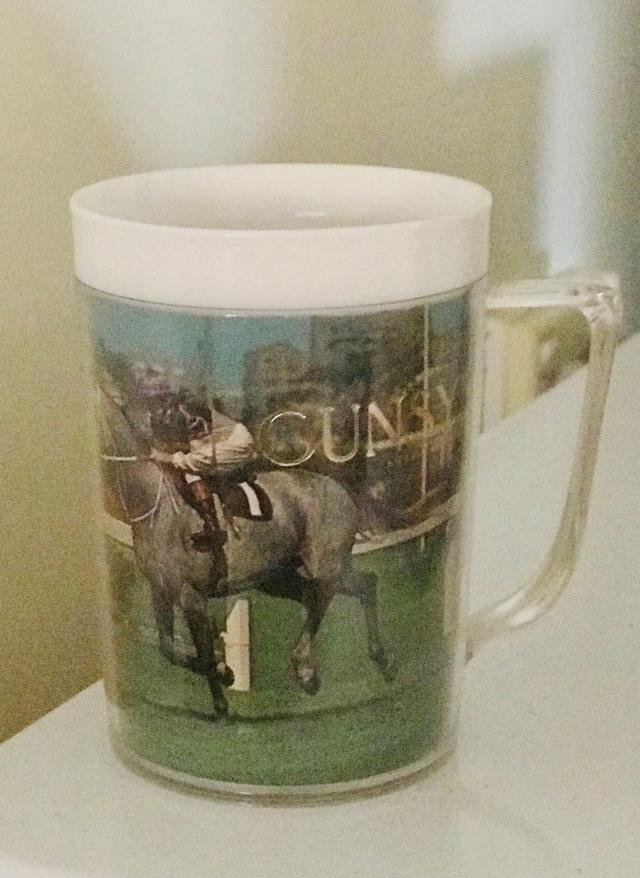
Like a rock star, Gunsynd even had a farewell tour of exhibition gallops ending at Doomben racetrack in May 1973 in front of a crowd of more than 25,000 with merchandise including tea towels, cups and trays selling out before he even stepped onto Doomben racecourse.
In 2004, Gunsynd was listed as one of the top 12 Queensland icons and was inducted into the Australian Racing Hall of Fame in 2005.
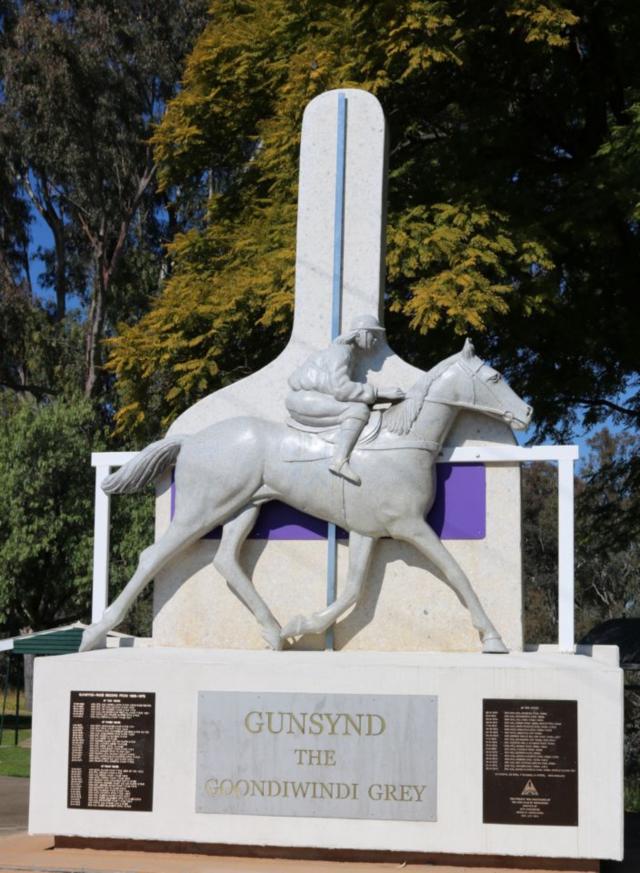
Before this, his legend was immortalised in a statue on the banks of the Macintyre River in Goondiwindi.
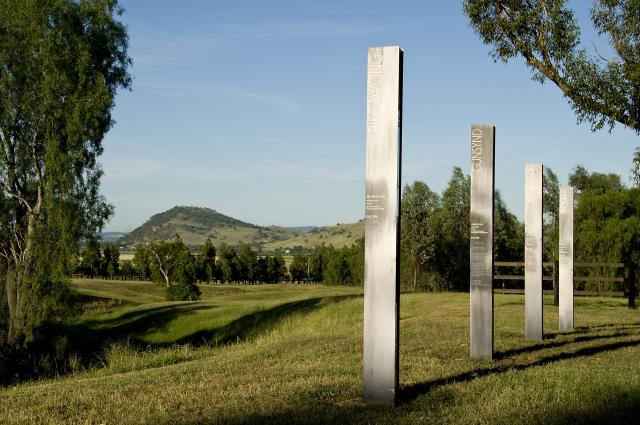
And, with the establishment of the nearby Gunsynd Museum, which was officially opened in 2007 when part-owner Bill Bishop cut the purple (his racing colours) entrance ribbon, the full story of this Australasian champion is on display for all to see, meaning the Gunsynd legend will live forever.